Showing posts with label divers watch. Show all posts

Sunday, March 24, 2013

Seiko Sumo Scuba Divers Watch Review

You might be wondering why only now?  Why do the review on the Seiko Sumo when it has been around for 5 years already? Well, we think its never too late to write some thoughts on a spectacular piece such as the Sumo and honestly when can a watch geek ever stop talking about, looking at, admiring the Sumo.  Exactly why still we ask?  Here's what we think.


The Sumo, nicknamed by the fans on popular Seiko forums, was released way back in 2007 as part of the Prospex line, which stands for Professional specification.  From afar, the Sumo looked like another dressy diver that rolled up from the Seiko production floors in Japan to accommodate only the watch enthusiasts in their homeland.  But as soon as people started wearing them, and considering numerous stocks crawled out to other countries in Asia and even in the Americas, the owners themselves realized that this was just not another dressy desk diver to toy with, but this may very well be the "perfect" dive watch in any scale it  be.


What does that mean? Well the word perfect is a very strong descriptive word but that is exactly the word I uttered once I put in on and gave it a thorough review for almost an hour.


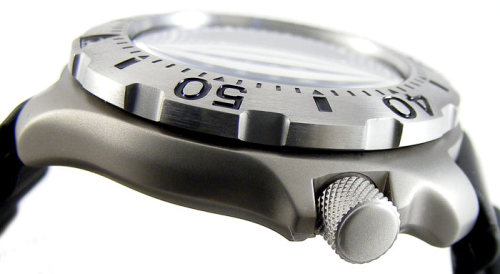
For one, the case design tops the list.  The case is classic representation of art in the hands of a watchmaker or shall we appropriately say hands of a robotic case machining machine. A quick glance along the sides of the case shows you detailed brushed and polished lines alternating like it was cut through a wind tunnel to flow through smoothly in the ocean.  The 44mm case, to which is kind of normal size for watches nowadays, stands perfectly on the wrist and flows smoothly as you move about.  The lugs extend long on the top and at the bottom giving the watch a good grip to stay flat on the wrist.  And speaking of long lugs, the Sumo's are one of the most beautiful I've seen in a divers watch.  The wide arched top to the narrowed end with chamfer going to the center where the bracelet solid end links meet, the total physique is just genius design and a work of art.


The Sumo doesn't have a crown guard.  And I would strongly agree with the designer on this move.  Crown guards would radically destroy the beauty and grace of the case.  And besides, positioning the crown at 4 o'clock serves the purpose already for both comfort and protection.


The rotating bezel, as customary in any analog diver watch, sits nicely on top of the case with the sides slightly covered by the case while the lug area is open for the user to operate.  Operation is quite smooth, not too hard, and not too smooth.  One thing I really like about this bezel is the insert has a recessed inner area which complements nicely going to the crystal giving the bezel insert more body and complexity.  Something you don't see quite often even on the Marine Master or even on Submariners.  The markings on the insert is wide and unique, a perfect match for the Sumo's case.


The Dial, oooh the dial. May it be black, blue or orange is just perfect too.  The large hour circle markers give that maxi look.  The controversial 12 hour indice together with the 9 and 6 o'clock markers complement the whole package with simplicity yet unique.  The date aperture shows the white date disk, where some preferred it to be black, but believe me it looks better the way it is, balancing the 9 o'clock marker.  And the all white 4 liner markings "Seiko", "Automatic", "Scuba", "200M" is also again perfect. Not cluttered, not sterile, just.....right.


The hands too are big and bold, leaving no time unnoticed while the subtle second hand glides smoothly along.  The tip of the second hand is inspired from the 6105's which I say is truly unique to Seiko.

Many have said that the weakest link of the Sumo is its crystal.  And that Sapphire is the best crystal for any watch especially for a Sumo in its price range.  Well, many have also countered that thought about the properties of mineral crystal that is more advantageous compared to that of Sapphire.  Seiko's Hardlex mineral crystal may scratch, but will never break and shatter.  It's more function and durability and puts aesthetics as second priority. Like what we have now with our cars, the window glass doesn't shatter like they used to in case of accidents, and of course we passengers don't want that.  So I guess I rest my case for the Sumo's crystal.  It rightfully deserves the famous Hardlex mineral crystal.


The Sumo's engine is Seiko's mid level 6R15 inhouse movement.  In a nutshell, its quite an upgrade which was based from the massly popular 7S26 movement that has hacking and winding capabilities.  But most importantly, 6R15 uses a more advanced Seiko Spron spring for its main spring and balance wheel, giving the Sumo more power reserve and better precision in achieving accuracy.  An in-depth review can be found at the Seikoholics corner.

Link to Seikoholics.


And lastly, the bracelet is solid stainless steel that is nicely decorated from the solid end link up to the clasp.  The 20mm lug width shouldering the wide 44mm case is unbalanced to many, but the ratio difference makes the look give more attention to the watch head and that the bracelet is there to support it.  That is what I hate about thick straight bracelets, it's like it's stealing the show of the watch itself.  It's well made and well finished, with extension clasp and double push botton folding clasp.  Some have preferred swapping it with Marine Master's ratcheting clasp, but the price for this additional accessory doesn't make it practical at all.  It would have been a miracle if Sumo would have this as its stock clasp.


If we look at pure current Seiko classic divers line, the four models below would come to my mind.  They represent the different levels of Seiko classic divers at different levels of price, finish, movement and overall value.  The SKX007 priced at $150-$200 is the entry level where everything is basic yet still very respectable and is the direct descendant of the classic Seiko divers watch.  The SBDX001  aka MM300 is priced around $2,200-$2,500.  Considered the grail for seikoholics sports a high end 8L35 Grand Seiko movement housed in a greatly finished monocoque case.  And the holiest grail will be the SBDB001 SD600 with GMT that is without barking into any Grand Seiko territory.  At a price point of around $4,000, it has the "best of both worlds" 5R66A spring drive movement, incredible finish with additional power reserve and GMT indicator.  With that line-up, I believe the Sumo SBDC001 has the perfect balance of price practicallity with outstanding value and quality and undeniable iconic design.


The Sumo, when it was released in 2007 had the price tag of almost $500.  Now its on the level of around $600.  The increase is primarily due to inflation of course the demand of this piece as people knew more about it.  Now we don't know exactly when Seiko stops making the Sumo, but I kid you not, as soon as the Sumo line finishes off with the last piece, the second hand market will quickly rise to its feet and accomodate the Sumo with a higher price tag worthy of its value.


and more pics to prove my point.


Here is an amazing detailed video from Watchtanaka.


Saturday, February 18, 2012

WWR #19 Citizen Promaster Titanium Divers Watch NY0054


 Looking for your first titanium watch? Well here's the most affordable diver's watch that is cased in Ti.
Ironically, I have never considered about the dive watches by Citizen. They just did'nt fit bill on the perspective of my taste.  But for this specific model, did.  It sung to me.  It looked mean but not overboard unlike the Seiko monster, its case, dial and hands are roundly soft like designed after water dynamics.  This design I won't get bored after a few years.

here are some specs at $190-200 price range.  Talk about bang fir your buck!
Specs:

Cal. No: 8203, automatic, handwinding, hacking
Black dial with super luminous hand and dot markers
Full titanium back and case
Screw back case
Black rubber strap
Sweeping second hand with luminous features
Stylish traditional uni-directional rotating sporty diver bezel with 60mins scale
Screw-down Locking Crown at 8 o'clock position

Water Resistant 200m (20 bar)

N.D. Limits table(No Decompression limits table) imprinted on the wrist band, this table indicated the permitted time limit without decompression according to the depth.

Approximate measurements
Bezel diameter: 40mm, Case diameter:44mm including crown
Case thickness: 10mm

Here are some explosive pics of this not so common watch...


A blue variant of the watch which I have to say brings good old blues to you...

Sunday, January 1, 2012

WWR 16#: Seiko SBBN011 Darth Tuna Professional Divers Watch


In the world of dive watches, there are only a few brands who really have a real rich history with the art and science of diving.  In my best of knowledge and opinion, I'm not a diver in any level, there are three types of dive watches in the market.  There are desk divers, ISO rated divers, and professional dive watches.  Well now of course these watches are really just accessories, dive computers now do the real guide for the divers, but way back then, the reliability and functionality of dive watches under the vigorous environment under water meant life and death for the diver.   

Seiko is one of the brands who offers those three types of watches (including a dive computer). And during 1965, they came up with a complete redesign from their usual divers watches and came up with the Tuna.  Well its called that by its fans because it just resembles a tuna can.  Flashforward to 2010, they now came up with a blacked out version of this Tuna and now with an ever reliable Seiko quartz movement.  This is my WWR # 16, the Seiko SBBN011 Darth Tuna.

Specs of this awesome and massive divers watch.

Movement 7C46 Quartz from Japan
Sapphire Crystal
Unidirectional Bezel
Titanium Case, Ceramic Guard
48mm Case Diameter
15mm Case Thickness
1000m Water Resistance

What really struck me about this watch is how it wears on your wrist.  Before, looking at pictures of all Tunas, I could just not fathom wearing a hockey puck on your wrist.  But when I actually tried this on for size, it seems I could not get it off and the sales lady was expecting me to get it already.  It wasn't too big, well for the contemporary sizes of watches nowadays, I mean you could literally wear it casually and not emit some show-off presence that your wearing the monster of all watches, and my watch will eat yours kinda type.  I believe its size was meant for something.  I also like the originality in design that it helms from the classic Seiko divers watch, those arrowhead hands and hour indices, but are bigger, bolder and badder considering its size and functionality.  Its standard rubber strap is a sturdier vent type of divers strap that has a blacked out buckles and I would say more comfortable that the Seiko Z22 rubber straps that comes with mose Seiko Divers Watches.  Considering this to be 1000m, without a helium escape valve is an extraordinary feat by the case itself.  The design of the tuna is also not for fashion or in any sense like that, its not a bling out substance, as it roars for the rough oceans and the pressure of the deep.  


Here are pics borrowed from all over the net.


Friday, November 18, 2011

My Seiko 6309-7040 Story

It was about 3 years ago, just the usual day scrolling around the web for more information about a new found passion: watches of course.  And since I only had one Seiko back then, I was completely blown away by how many collectors of Seiko there are and the different styles and lines that Seiko has that people collect.  And it was in one image I forgot what forum it was that the owner showed a wrist shot of specific Seiko Diver to which I have never seen before.  Well from the watch stores at least.  It was the first time I saw it.  The image had some title on the bottom, its reference number and possibly the date of the watch, It s 6309-7040 and year 1976 respectively.  Since that day on, that that specific reference number has somewhat implanted in my WIS brain and has never left since.

What is it about the 6309?  For one, I think it has a lot to do with the cushioned case.  Well the 6105 also had a cushioned case but IMO it was too wide for my taste as it pairs its 19mm lugs.  The 6309's are just perfect and just right.  It's like that perfect curve of a woman on the ratio of the chest to waist to hip, like those on Jessica Alba or Olivia Wilde, and not the Lorno type that you see from the Kardashians (I can't believe I just made reference to a woman's body to watch, what is happening to me!).  Well you know what I mean.

The crown on the 6309 neatly tucks in the cushioned case  without needing extra metal for crown guards, the cushion does the cushioning itself. And since it is a tube type crown, unlike the later versions of the Seiko Divers wear it kinda sits on the stem and quite hard to screw in if you done get the grooves aligned right.  On the 6309, its such a breeze.  The tube under the crown guides your fingers all the way to those nice curvy hips I mean case.  

I also like the look better with round/circular indices (submariner influence on me maybe).  But they really strike artful balance to a circular dial rather than rectangular indices.  And the special 12, 9 and 6 o'clock markers are right on the spot, especially the sword shaped marker on the 12 o'clock, ugh I could stare on them forever.

The 6309/6306 (hacking version type) was also the first Seiko Diver model to have this set of arrow type hands, to which is used in a lot of Seiko Divers and Sports models up to this day.  

And, some say the 6309 movement is also a bullet, well can't attest to this for now but I think all Seiko movements are :)

Now going back to my story.  So it really didn't come to my plan to get one.  I mean,  during that moment, it never crossed my mind to get a vintage watch.  But as soon as had some sources for one, I tried to check it out.

I met up with the seller to check the 6309 he was selling.  The initial information he told me that he had a good condition 6309 that was ready to wear and did not need any refurbish or repair.  Upon seeing the watch, I was like "whoah finally a 6309 in my hands" you know kinda star struck.  But it kinda quickly went away when I noticed that the dial was too new for a 20 plus year old watch.  Yes it was aftermarket.  and So was the bezel insert and the hands.  The rubber strap was also aftermarket, and you guessed it, so was the spring bar, was thin as hell.  It was then I realized that I was kind of a purist.


I also requested the seller to open up the case-back to check if it really had an authentic movement. It did though, but it did not look good.  The rotor had brown colored stains on it, may be some dirty pitt but could not be rust I thought.

Here is a quick wrist shot (blurry shot sorry) of the watch (with all the aftermarket parts) when I got it.


So, with all this at hand, I decided to get the watch since the movement was original, the case and caseback was still in good condition, a little WABI but as expected on a vintage watcg. Then I set-out to restore it with orignal parts as possible or where feasible.

For the dial, I requested the seller if he could acquire some old original 6309 dials so I could switch it with the aftermaket.  So does with the Bezel insert. I wouldn't care if there were some WABI in it just as long as it was original or a correct aftermarket. And luckily just after a few days, he contacted me and got me a original non-suwa dial with some patina and dirt on the lume and a correct aftermarket bezel insert with minor WABI all over.

Here is the comparison of the original dial and the aftermarket.

Aftermarket Dial - Seiko Logo.  Observe the print on the hour indices and Seiko logo is kinda blotchy and thick.
 

Original Dial with some patina, WABI - Seiko Logo.  Observe how the prints on the hour indices and the Seiko Logo is finely printed.


Aftermarket dial with 150m water resist print.  The 150m print is still blotchy but the Water Resist print is rather fine in my opinion.


Then the 150m water resist print on the original dial.  The Water Resist print has faded to pale yellow but the 150m  is clearly in fine print.  This is what they call a Non-Suwa dial as clearly there is no Suwa Logo right below the WATER 150M RESIST print.


At the bottom of the dial, bears some writing and references to where it was made.
This is the aftermarket dial and it's writing below.  Print still blotchy and not quite clear. the "9" on the 6309 print is even incomplete.

And here is the print on the original dial. Also finely printed and clear after all this years under the sun.  From the reference on"6309 Collector's Buying Guide" on watchuseek forum, this dial was made in Singapore.


And the comparison for the bezel insert.

Aftermarket wrong bezel insert.  Lume pip sits on top of the insert and the capped "1" on the 10 marker.

And the correct bezel insert.  Lume pip is embedded on the insert and the correct "1" font on the 10.  The dots that make up the minute markers also are bigger in size.


Extensive references where from this link, you'll find this very useful as it did to mine.
http://forums.watchuseek.com/f281/how-buy-seiko-6309-diver-collectors-buying-guide-140799.html

 
Here is the watch head now with orginal dial with patina. The hands are still aftermarket, as original ones in good clean condition are rare to find as with the bezel but as long as it's the correct one.


Then I sent it out to Seiko Service Center for a full movement overhaul and for it to be regulated.  Prior sending it for repair, it was running +2 mins per day and sometimes would stop running even though I was wearing it. 

Initial check-up from the watch technician indicated that the balance wheel and plate need to be replaced.  So with the gaskets.

I waited for almost a month before the watch finished it's service. I then requested the watch technician to open up the case back so I could take a cell phone quick shot of the movement.

Here is the pic of the movement, all cleaned up and ready to run.


Here the pics of the old plate.  Notice the grime on the rotor ball rollers.  Figured this caused the inefficient winding.


And the old balance wheel. Can't really say what's wrong with it but might be the performance that needed it to be changed.

It now runs +15-20 secs per day.  Not a chronometer spec but I believe within tolerance to the specs of this movement.  I plan to get it back to Seiko to be regulated again as I do believe this can still be improved.

I then strapped it up with some Seiko fat spring bars and a Maratac Zulu Strap, and now here it is, ready for more years of ticking.


Some photo sessions with an old book by Hemingway...


And some pictures with its successors...a 7002-700A Pepsi Diver, and the SKX007.  If you look at it closely, the aftermarket second hand on the 6309 has a longer tip after the circular lume marker compared to the original second hand on the 7002.  As for the bezel insert, the aftermarket one on the 6309 doesn't create a shadow at the edges of the lume pip, while the original inserts on the 7002 and SKX have deeper lume pips which create an inner shadow. 


The Seiko 6309-7040, trusted and loved by so many.  A basic divers watch that has truly become an icon in Japanese Horology, capturing the wrists of many WIS from any continent in the world.  27 years has passed since mine got off the production floor, I did not cause its scars, I did not wear its gears, but I believe I have given life back to this watch and gave it all needed attention and care that I hope it could live again for another 27 years...or more.